Most fleet operators already use some form of software. They have dashboards showing vehicle positions. Alerts when something breaks. Weekly reports with utilization charts. And yet, most of them still spend their days reacting – to a vehicle that didn’t rebalance in time, to demand that spiked without warning, to a maintenance issue nobody flagged until it caused a breakdown.
The problem isn’t the data. Most operators have plenty of data. The problem is that traditional software shows you what happened. It doesn’t think. It doesn’t decide. It doesn’t act.
Agentic AI is different. It doesn’t wait for a human to open a dashboard. It monitors, reasons, and acts – autonomously, in real time, across the full complexity of a live fleet operation.
This guide explains what agentic AI actually means in a fleet context, how it works operationally, and why a growing number of mobility and logistics operators are treating it as the most significant shift in how fleets are run in a decade.
What is agentic AI? (and what it’s not)
The word “agentic” comes from the concept of agency – the ability to perceive an environment, reason about it, and take action toward a goal. An AI agent isn’t a tool you query. It’s a system that works continuously on your behalf, without waiting to be asked.
This is a meaningful distinction from what most operators have today.
Beyond dashboards and alerts
Dashboards are passive. They show you data when you look at them. Alerts are reactive – they notify you that something already went wrong. Neither one helps you avoid the problem before it happens, and neither one does anything about it once it occurs.
An AI agent doesn’t wait. It monitors continuously, detects patterns before they become problems, and takes – or recommends – action while there’s still time for it to matter.
Beyond rule-based automation
Rule-based automation is also not the same as agentic AI. A rule can tell software to send a notification if a vehicle hasn’t moved in four hours. But a rule can’t reason about why the vehicle hasn’t moved, whether that matters given current demand, what the optimal corrective action is given current crew availability, or what the downstream effects of that action might be across the rest of the fleet.
Agentic AI reasons. It handles context, uncertainty, and trade-offs – the things static rules can’t capture.
What makes AI truly “agentic”
An AI system is agentic when it can do four things consistently:
- Perceive – read the current state of your operating environment in real time
- Reason – understand what that state means, what’s likely to happen next, and what the right response is
- Act – execute a decision autonomously, or surface a specific, contextual recommendation with full supporting logic
- Learn – improve its reasoning based on the outcomes of past decisions
In a fleet context, this means software that behaves less like a reporting tool and more like an experienced operations manager who works continuously, processes information across the entire fleet at once, and never misses a signal.
Why fleet operations are the ideal environment for agentic AI
Fleet operations are inherently complex. Dozens or hundreds of vehicles. Constantly shifting demand. Maintenance schedules. Driver availability. Zone regulations. Weather. Events. Disruptions. Every day presents a different operational configuration, and the right decision at 9am is often wrong by 2pm.
Traditional software wasn’t built to handle this kind of dynamic complexity. It was built to record what happened and display it to a human who would then decide what to do. Agentic AI was built to handle the complexity directly.
The complexity problem – too many variables, too little time
A fleet manager for a shared mobility operator might be responsible for 200 vehicles across 15 zones. At any given moment, there are vehicles stuck in maintenance, zones about to run dry, demand spikes forming near a transit hub, and rebalancing tasks competing for a limited crew. No human – and no dashboard – can simultaneously process all of that and make optimal decisions in real time.
Agentic AI processes all variables continuously: every vehicle, every zone, every demand signal, every constraint. It identifies what matters most and acts on it — not after a human notices, but as it happens.
The data problem – fragmented systems, no single truth
Most fleet operators have data scattered across multiple systems: a telematics provider, a maintenance platform, a booking system, and manual spreadsheets for crew and exceptions. These systems rarely communicate with each other. The result is that no single person, and no single tool, has a complete, real-time picture of what’s happening across the operation.
An AI agent connects to these sources, synthesizes them into a unified operational view, and reasons across all of them simultaneously – something a human operator cannot do at scale, no matter how experienced.
The decision problem – reactive vs. proactive operations
The biggest operational cost isn’t what you can measure on a dashboard — it’s what you missed. The demand that went unmet because vehicles were in the wrong zones. The vehicle that failed because maintenance was delayed by a week. The zone that underperformed for three weeks before anyone noticed the pattern.
Agentic AI shifts operations from reactive to proactive. It identifies and acts on emerging situations before they become problems, not after the cost has already been incurred.
How agentic AI works in fleet operations
Understanding the mechanics helps separate genuine agentic systems from products that use the term loosely as a marketing label.
Perceive – reading fleet state in real time
The agent starts by continuously ingesting operational data: vehicle positions, battery or fuel levels, booking volumes, maintenance flags, zone demand signals, weather data, and external event calendars. This isn’t a periodic data pull. It’s a continuous, live feed that keeps the agent’s model of the fleet current at all times.
Reason – connecting data to operational context
Perception alone isn’t enough. When vehicle #47 has been stationary for three hours, that observation could mean several different things: a scheduled charging cycle, a driver break, an unreported maintenance issue, or a misplaced vehicle that nobody has acted on yet. An agentic system reasons about which interpretation fits the current context – and then weighs the implications against demand conditions, crew availability, and fleet distribution before forming a conclusion.
This reasoning layer is what separates agentic AI from monitoring dashboards and rule-based alert systems.
Act – from insight to specific operational decision
Based on its reasoning, the agent either acts autonomously within defined operational parameters, or surfaces a specific, contextualized recommendation. Not just “vehicle #47 is stuck” – but: “Vehicle #47 appears to be in unlogged maintenance. Consider reassigning the Zone C rebalancing task to vehicle #52, which is idle 1.2km away and available now.”
The output is specific, actionable, and ready to execute. The human confirms or adjusts; the routine decision happens automatically.
Learn – improving with every operation
Agentic systems improve with use. Every decision becomes a data point: which recommendations were acted on, which predictions were accurate, where the reasoning was miscalibrated. Over time, the agent becomes more precisely tuned to the specific patterns of your fleet, your zones, your demand environment, and your operational constraints.
What agentic AI can do for your fleet today
These are not theoretical capabilities. They are operational use cases being deployed in live fleet environments.
Demand forecasting and proactive rebalancing
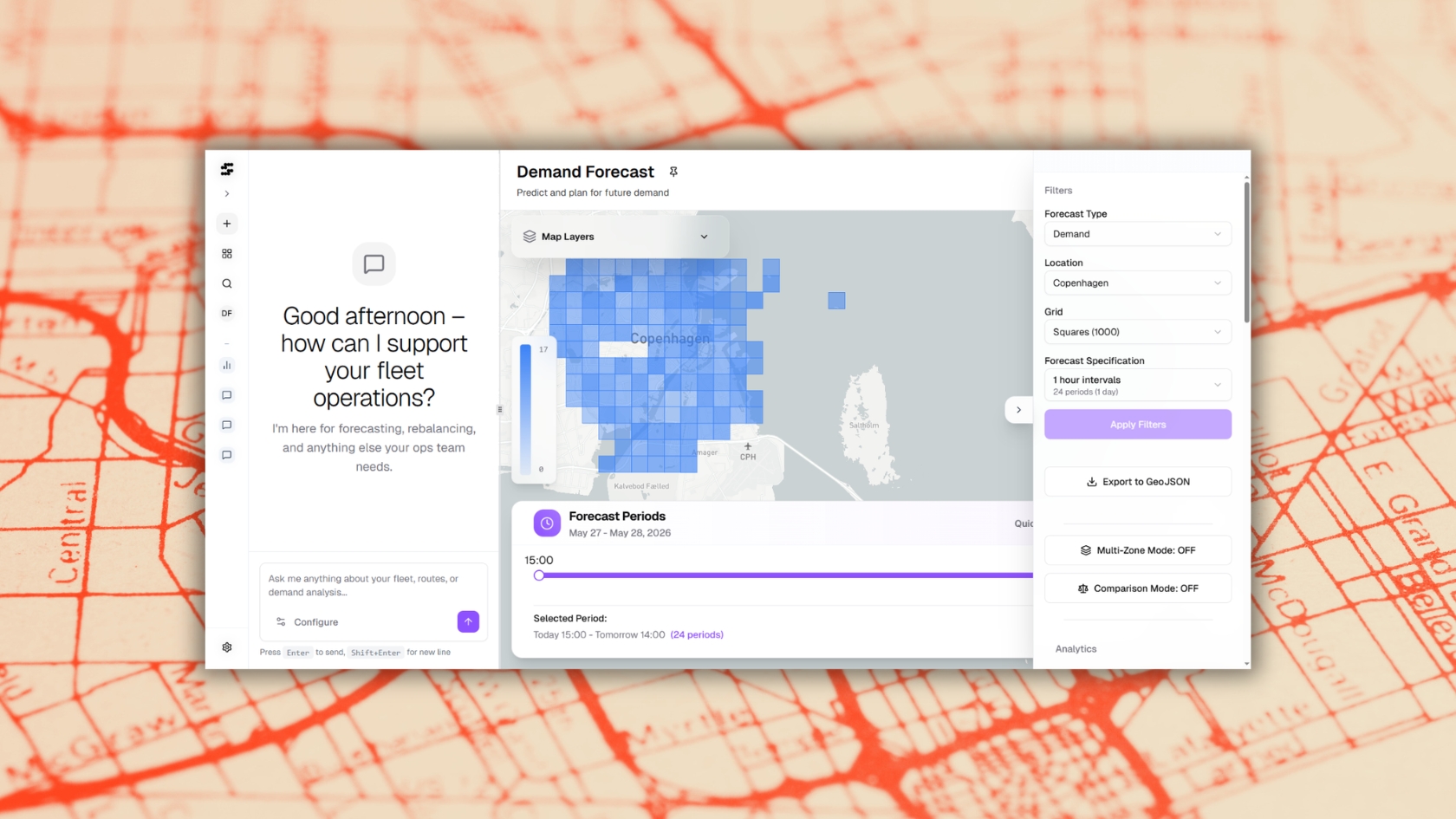
Instead of reacting to empty zones after the fact, agentic AI predicts demand hours ahead – and triggers rebalancing tasks before the gap appears. The result: fewer missed trips, better vehicle utilization, and less wasted crew movement. Operators using SWITCH have achieved forecast accuracy above 90% for planned demand scenarios, including major events and seasonal patterns.
Maintenance and vehicle availability management
An AI agent monitors the full vehicle lifecycle: usage intensity, reported fault codes, maintenance history, and predicted failure patterns. It flags vehicles at elevated risk before they break down, suggests maintenance windows that minimize operational impact, and tracks whether scheduled maintenance is actually being completed on time. The result is higher fleet availability and fewer unplanned outages during peak hours.
Disruption detection and operational resilience
When a transit strike reshapes demand across an entire city, when a major event moves vehicle needs across three zones overnight, or when weather shifts utilization patterns in ways that take human operators hours to notice – agentic AI detects the signal early, models the operational impact, and recommends or executes a response. Operators focus on decisions that require human judgment; routine adaptive responses happen automatically.
Planning-to-execution without the gap
The most expensive failure in fleet operations is the disconnect between planning and execution – where a well-designed operational strategy falls apart because the teams on the ground don’t have the right information at the right moment. Agentic AI closes that gap by connecting strategic forecasts to real-time operational decisions, continuously, without requiring a human to translate between the two.
Agentic AI vs. traditional fleet software
| Traditional fleet software | Agentic AI | |
|---|---|---|
| Core function | Records and displays operational data | Perceives, reasons, and acts on operational data |
| Decision-making | Human reviews dashboards and decides | Agent surfaces specific recommendations or acts autonomously |
| Timing | Reactive – responds after the fact | Proactive – acts before the problem materializes |
| Handles complexity | Single-system view, manual synthesis | Cross-system, multi-variable, continuous processing |
| Improves over time | Static rules and reports | Continuously learning from outcomes |
| Crew requirement | High – significant manual monitoring | Lower – agent handles routine decision-making |
What to look for when evaluating agentic AI for fleet operations
Not every product that uses the term “agentic AI” delivers genuine agentic capabilities. These questions help separate the real from the relabeled.
Does it connect to your existing data sources?
An agentic system is only as capable as the data it can perceive. Ask vendors specifically which telematics systems, booking platforms, and maintenance tools they integrate with – and how current that data is. Real-time operations require near-real-time data. Hourly syncs are not enough.
Does it reason or just report?
The clearest test is the output. Does the system tell you that something happened, or does it tell you what to do about it – and why? If every output is a chart, a table, or a generic alert, it’s a reporting tool. If the output is a specific, contextualized recommendation with supporting logic, the system is reasoning.
Does it act or just alert?
Alerts have value. Automated action is better. Ask what the system can execute autonomously within configurable parameters, what it escalates to a human, and what that escalation looks like in practice. A genuine agentic system makes a clear distinction between decisions it can make on your behalf and decisions that require your judgment.
How SWITCH uses agentic AI in fleet and mobility operations
SWITCH builds agentic AI software specifically for mobility and logistics operators – not a general-purpose AI assistant, but a system designed for real operating environments where decisions affect vehicles, routes, crew, service quality, and profitability every hour.
SWITCH AI Agent connects to your operational data, reasons across forecasts, fleet state, demand signals, and external context, and delivers specific actionable recommendations – or executes actions autonomously within parameters you define. Urban CoPilot handles day-to-day execution and fleet workflow optimization. Urbiverse enables simulation-driven planning: testing scenarios, sizing fleets, and planning infrastructure before committing resources.
Operators use SWITCH to move from reactive operations to proactive, AI-driven fleet management. Elerent saw a 25% improvement in fleet performance. Wayla achieved 92% demand forecast accuracy before launching a new mobility service.
Frequently asked questions
What is the difference between agentic AI and traditional AI in fleet management?
Traditional AI in fleet management typically refers to predictive models — demand forecasts, maintenance risk scores, utilization projections — that produce outputs informing human decisions. Agentic AI goes further: it monitors the environment continuously, reasons across multiple data sources, and acts – autonomously or via specific contextualized recommendations – without waiting for a human to initiate the process. The key difference is operational autonomy.
Is agentic AI ready for real fleet operations today?
Yes. While “agentic AI” is a relatively recent term, the underlying capabilities – continuous monitoring, predictive modeling, autonomous decision support, and outcome-based learning – have been deployed in production fleet environments. Purpose-built platforms like SWITCH now make these capabilities accessible without requiring expensive custom development for each operator.
How long does it take to implement agentic AI in a fleet operation?
Most operators start with a focused pilot – connecting one or two data sources and deploying the agent in a defined operational context – before expanding across the full fleet. A well-scoped pilot typically delivers measurable results within 4 to 8 weeks.
Which types of fleet operators benefit most from agentic AI?
Operators who benefit most tend to share a few characteristics: fleets large enough to generate meaningful operational complexity (typically 50 or more vehicles), operations where demand is variable and rebalancing matters, and teams that currently spend significant time on manual monitoring and reactive decision-making. Shared micromobility, car sharing, car rental, last-mile logistics, DRT, and corporate fleet operators are all strong fits.
Conclusion
Agentic AI isn’t a feature you add to an existing dashboard. It’s a different operational paradigm – one where software doesn’t wait to be consulted, doesn’t just report, and doesn’t leave complex decisions entirely to a human working from yesterday’s data.
For fleet operators managing real complexity – shifting demand, distributed assets, fragmented data, and decisions that need to happen in minutes – agentic AI represents the most significant operational shift available today. The operators who move first build a structural advantage that compounds over time.
→ See SWITCH AI Agent in action — request a free demo